

At SOF Week 2026, Geourg Kivijian wasn’t handing out business cards. He and co-founder Armen Arakelyan walked the show carrying a drone that looked like a bird. Their startup, Ornadyne, wants to put a crow-shaped, propeller-free surveillance drone in warfighters’ hands within a year. The drone is the O1, the company’s flagship product, is a biomimetic ornithopter, a fixed-wing-class aircraft that generates lift and thrust through wing flapping rather than rotary propulsion. Founded only months ago, Ornadyne is already operating a flying prototype and has been accepted into Y Combinator’s Spring 2026 batch. Read on to learn why we predict this company is going to fly high.
From NASA JPL and SpaceX to a Bird-Shaped Military Drone Startup
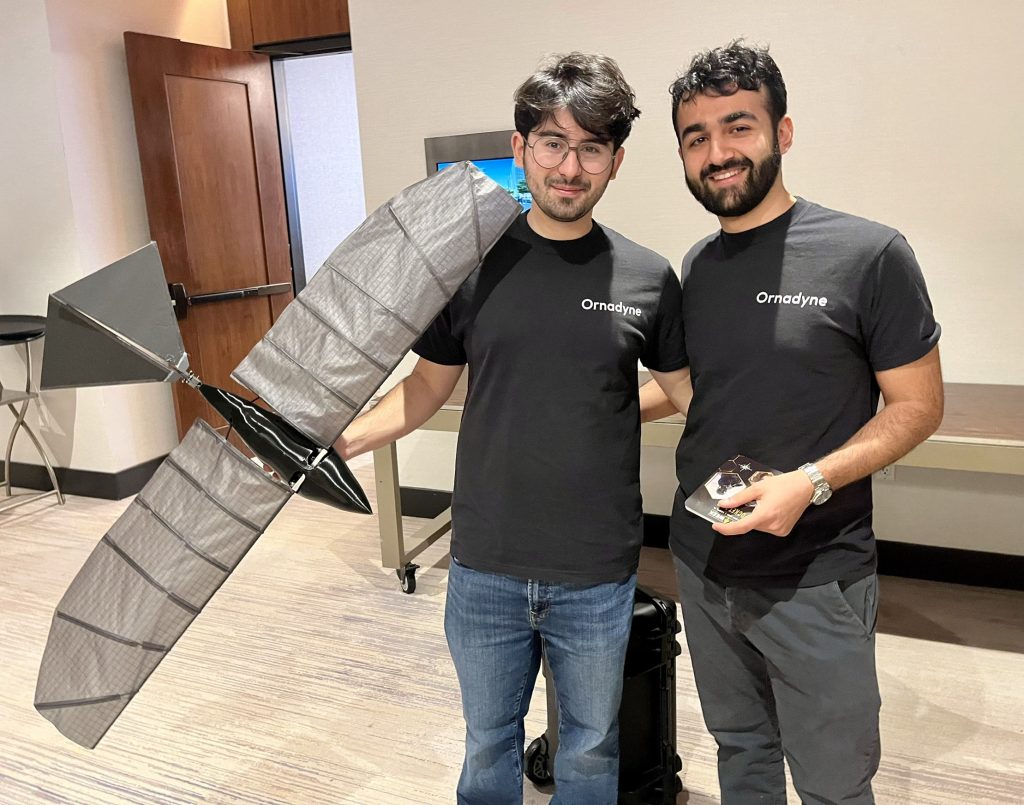
Ornadyne’s two founders didn’t come from the defense industry. They came from space, and met in middle school.
Kivijian completed his master’s degree at Cal Poly, where his thesis focused specifically on flapping-wing robots. He spent more than two years designing, developing and testing those systems, publishing award-winning research at IEEE and AIAA conferences before heading to, NASA JPL, and AstroLab, where he worked on Mars and lunar surface missions. The jump from planetary robotics to military ornithopters isn’t as wide as it sounds, he said. Both demand lightweight, high-efficiency mechanical systems that perform in unforgiving environments with no margin for failure.
Arakelyan took a different path to the same place. He studied astronautics at USC, where he served as machining lead at the university’s rocket propulsion lab, a team that set the world record for highest-altitude amateur rocket ever launched. From there, he went to SpaceX, where he spent a year before his old friend from middle school came calling.
Ornadyne is thus built on two engineers with deep technical pedigrees in some of the most demanding aerospace environments on earth (and space) and a shared conviction that the ornithopter’s moment has finally arrived. Kivijian had been watching European and Chinese academics quietly break endurance records for flapping-wing aircraft, and when he saw the People’s Liberation Army (PLA) taking a serious interest in the technology, he stopped waiting.
“I was like, okay, there’s a market for this because China is doing it now with the PLA,” he said. “And so I went and reached out to my good friend from middle school at SpaceX — and basically stole him.”
The Military Needs a Drone That Looks and Sounds Like a Bird
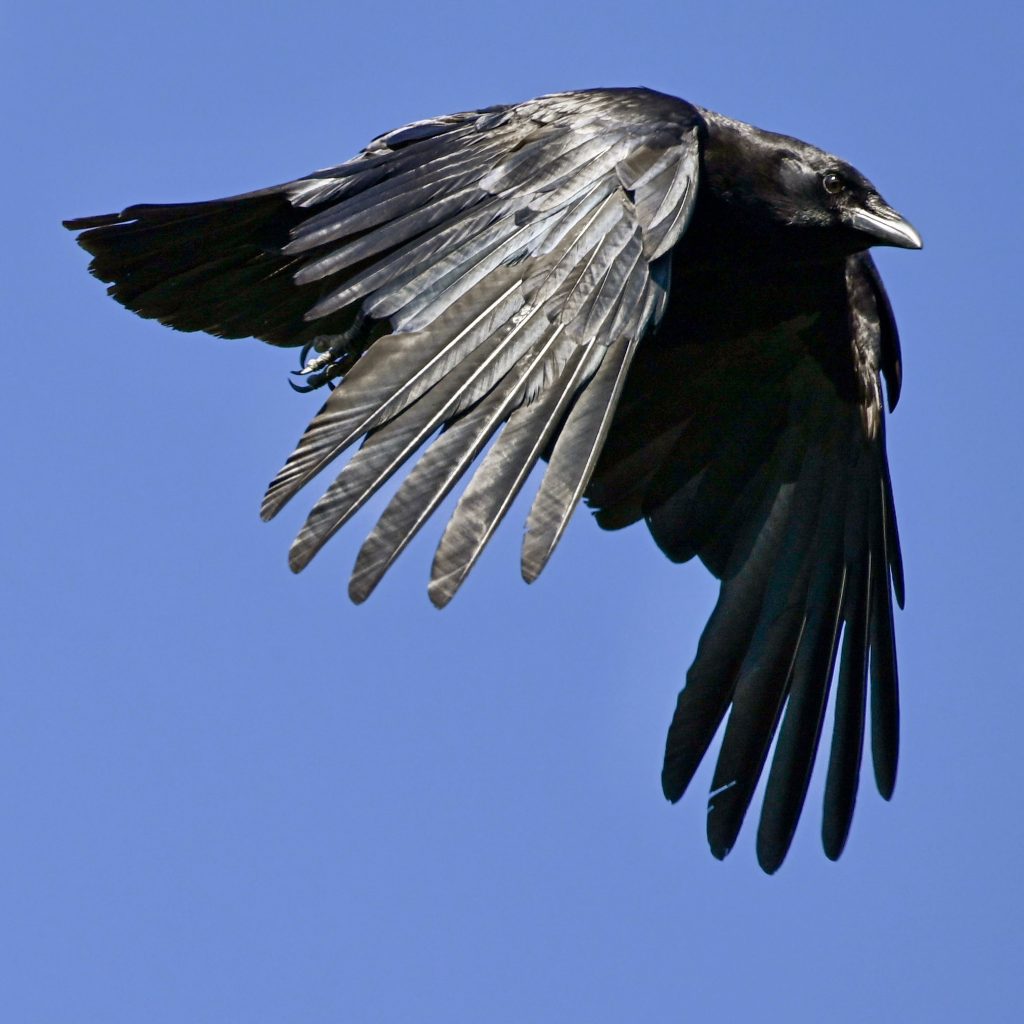
The tactical logic behind the O1 starts with a problem that has frustrated counter-UAS operators for years. Birds constantly trigger false positives in drone detection systems. Radar, acoustic sensors and electro-optical systems all struggle to cleanly separate biological fliers from small UAS in cluttered airspace. Most manufacturers treat this as someone else’s problem. Ornadyne built their business around it.
“Birds are actually the noise of counter-UAS detection systems,” Kivijian explained. “Our goal is to make something that actually blends in by being in the noise of the counter-UAS detection system software.”
The O1 exploits that gap deliberately. Because it mimics a crow in shape and flight profile, it occupies the same detection ambiguity zone that makes birds a persistent nuisance for C-UAS operators. The platform has no propellers, which also provides a significant acoustic advantage over conventional multirotor and fixed-wing designs that rely on spinning blades. That acoustic signature reduction allows the O1 to operate at lower altitudes without alerting targets on the ground, which in turn improves the quality of surveillance data collected by its onboard ISR payload.
Crow-shaped, the O1 has a one-meter wingspan designed to flap rather than spin. Its payload capacity sits in the 50-to-100-gram range and currently supports a camera for visual reconnaissance. Kivijian and Arakelyan designed the configuration lean and optimized for the kind of low-observable, close-in ISR missions that have become central to small-unit operations in contested environments.
And so Kivijian and Arakelyan showed up at SOF week, wandering the floor with their bird in hand and a mission in mind. “We want to put the technology that we have into the warfighters’ hands and get direct feedback from them,” Arakelyan said. “That’ll allow us to know exactly what needs to be focused on, what needs to be improved.”
Advances in Battery Tech and Wing Optimization Unlocked the O1
Ornithopters are not a new idea. DARPA funded the AeroVironment Nano Hummingbird over a decade ago. It generated considerable excitement before the program faded from public view. The concept of a bird-mimicking military drone never died, but kept running into the same wall: endurance.
“Back in the day, early 2000s when this was being explored by the U.S., battery technology just wasn’t mature enough to allow for long flight times,” Arakelyan said.
That constraint has fundamentally changed. European and Chinese academic researchers have spent the past several years pushing ornithopter endurance from minutes to hours, crossing a threshold that makes the platform operationally relevant rather than merely novel. This shift was not lost on Kivijian when he began developing the concept.
O1’s Development Timeline: TRL 4-5 in Two Months, Operators in 6-12
At the time of our SOF Week interview, the O1 had reached Technology Readiness Level (TRL) 4 to 5. This means the team had demonstrated the core technology in a relevant environment and confirmed they have a working flying model, not just a ground prototype. That progression from near-zero to TRL 4-5 occurred over approximately two months, an impressive pace. Within the same short window, the team also applied to Y Combinator Spring 2026 batch and got in.
Ornadyne’s near-term target is to deliver a high-fidelity system to military operators within six to 12 months. The company currently seeks demo partners, units, commands and individual warfighters willing to put the O1 through its paces and provide direct feedback on what works and what doesn’t.
That feedback loop is central to Ornadyne’s development philosophy. Rather than building to a requirements document generated in isolation, the team wants user input to drive engineering priorities. It’s an approach borrowed more from product development than traditional defense acquisition, and one that Y Combinator has made a signature of its defense-sector investments.
“Our biggest goal right now is to connect with users and people who can give us direct feedback,” Kivijian said.
How to Connect with Ornadyne
The O1 remains in active development, and Ornadyne is actively pursuing demo partnerships with military and defense community stakeholders. Those interested in evaluating the platform or providing operational feedback can reach the team through the company website at ornadyne.com or by emailing the founders directly at george@ornadyne.com or armen@ornadyne.com. Ornadyne is also active on LinkedIn.